Setups
Teaching from home when home is loud

The advice "find a quiet room" assumes you have one. This guide is for teachers who don't: parents teaching through the after-school window, tutors in shared flats, anyone whose classroom shares a wall with someone else's life.
First, an honest audit
Not all household noise is the same problem, and pretending otherwise is how teachers end up buying things that don't help. Sit where you teach, at the hour you teach, and sort what you hear into three bins:
Steady noise
Fridge, fan, air conditioning, distant traffic. The easiest bin — your platform's built-in suppression already eats most of it, and any dedicated tool removes it completely. If this is your whole list, you likely need nothing new.
Event noise
Doorbells, a dropped pan, the washing machine's spin cycle finale. Irregular, loud, but short. Software catches much of it; the rest is survivable because it ends. Your response matters more than the sound — more on that below.
Speech-like noise
Children, television, flatmates on calls, the neighbour's argument. The hardest bin: it lives in the same frequencies as your voice, so basic suppression either passes it through or clips you while deciding. This bin is what dedicated AI suppression was actually built for.
The schedule is a noise tool
Before software: the cheapest noise cancellation ever invented is teaching at a different hour. Marketplace tutors have unusual control here, and the teachers with the calmest audio tend to be the ones who noticed three things:
- Your loud hours are predictable. School pickup, dinner prep, the upstairs toddler's pre-bath sprint — chart one ordinary week and the pattern is embarrassingly regular. Block those slots in your booking calendar; a slot you never offer is noise a student never hears.
- Time zones are a gift. Students on the other side of the planet are awake when your household isn't. Early mornings sound expensive until you hear how quiet they are.
- The worst slot is worth less than it looks. One noisy trial lesson that doesn't convert costs more than the slot earned. If the 4 p.m. chaos hour keeps producing one-off students who never rebook, the hour isn't profitable — it just looks busy.
What software absorbs — and what it can't
With the audit done, the software conversation gets short. Steady noise: solved by the defaults. Event and speech-like noise: this is where a dedicated layer earns its keep. The main guide scores the options in full, but the household-specific summary:
- Krisp is the strongest answer to the speech-like bin — it separates your voice from other voices, which is precisely the trick a household demands. It runs beneath browser classrooms (Preply, italki and friends) via its virtual microphone. Pricing and the free-tier hedge are kept current on our Krisp for teachers page — verified 2026-09-20.
- NVIDIA Broadcast does excellent mic-side cleanup for nothing, if your machine has an RTX GPU. No affiliate relationship there; it's simply good.
- Nothing removes noise from your student's ears but distance and doors. Suppression cleans your outbound signal. If your co-teaching household member can be heard in the room by you, you'll still be distracted even while your student hears silence. Software fixes the lesson; it doesn't fix your concentration.
One honest warning about over-suppression. Aggressive settings can make you sound like you're teaching from a vacuum — and can clip the first syllable after silence. For language teachers, whose students need those syllables, we'd rather you run moderate suppression and tolerate a faint household than run maximum and lose consonants. Test with a recording, not with hope.
The scripts: what to say when home wins anyway
Some days the drilling starts mid-lesson. What separates professionals is not silence — it's the response. Three scripts worth stealing:
- The pre-emptive line (start of lesson, when you know it might get loud): "Quick note — there's construction next door this month. My noise filter catches most of it, but if anything slips through, tell me and I'll repeat." Thirty seconds, and every later interruption is now expected instead of unprofessional.
- The live recovery: don't apologise three times. Name it once — "that was my kettle, apologies — as I was saying" — and repeat the full sentence, not the fragment. Learners lose the sentence, not the word; give the whole thing back.
- The review-protector (after a genuinely bad one): a short follow-up message beats hoping. "Sorry about the noise today — it's fixed for next time. Here's a one-line summary of what we covered." Students forgive noise; they don't forgive pretending it didn't happen.
Households with children, specifically
The internet's advice for teaching parents is mostly fantasy ("explain to your toddler that mummy is working"). What actually moves the needle:
- Pick your battles by lesson type. Trial lessons and assessments deserve your quietest slots — they decide revenue. Long-standing students who adore you can absorb the occasional cameo; new ones can't.
- The door signal still works. Not for toddlers — for everyone else in the house. A simple visible signal ("door closed + light on = live lesson") cuts the accidental barge-ins that no software can retract, because the noise that hurts most is a door slam plus a full-volume question about dinner.
- Let the software carry the ambient layer. With a suppression layer on, distant play noise mostly disappears; what survives is proximity. The productive question isn't "how do I make the flat silent" but "how do I get eight feet and one door between me and the loudest human."
- Say the quiet part in your profile. Some of the best-reviewed tutors we've read state their situation plainly ("I teach from a family home; on rare occasions you may hear my kids for a moment"). It converts fine. Honesty reads as confidence.
Shared flats: negotiate the hour, not the silence
Flatmates are a different treaty than family. You can't parent them, and "please be quiet from four to nine" is how deposits get contested. What works is trading specificity for goodwill: name your two or three revenue-critical hours a week — trials, assessments, your best regular — and ask for those, precisely, in writing on the kitchen board or the group chat. People who'd bristle at a blanket noise rule will happily route their blender around "Tuesday 6–8." Offer the trade openly (their calls get the same protection), let the suppression layer absorb the ordinary hours, and keep the treaty small enough that everyone actually remembers it. A modest agreement kept beats an ambitious one resented — which, coincidentally, is also lesson-planning advice.
What we won't tell you to do
You'll notice this guide contains no foam panels, no "buy a better microphone," no closet-studio tutorials. Not because rooms don't matter — they do — but because gear and room treatment are someone else's beat and usually the wrong first dollar for a teacher whose actual problem is a 4 p.m. school run. The software layer travels with you, works in the flat you have now, and costs between nothing and $8 a month. Start there; escalate only if a month of recordings says you need to.
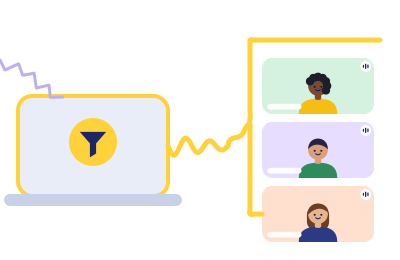
The household stress test
Run Krisp's 7-day trial across your loudest teaching week — not your quietest — and compare lesson recordings before and after. A week is enough to know whether the speech-like bin just disappeared from your professional life.
Rule 1 in action (Classroom Rules): this button is a paid link. If a Krisp subscription follows it, Krisp pays ChalkLine for the introduction, and what you pay stays exactly what krisp.ai charges anyone. Our scoring stays in the shipped script either way.